Founder & Principal Engineer

I design and build protocols that move money.

I am an independent protocol engineer. I take systems from the first architecture through the smart contracts, routing code, APIs, and deployment. I write the core, and I keep it running.

Flagship · Arc Mainnet · chain 5042

AchSwap

The trading system I have been building since November 2025.

AchSwap is a decentralized exchange aggregator and liquidity venue on Arc. Its own router reads pools from the DEXs it supports, compares that result with KyberSwap and LI.FI, and prepares the route expected to leave the most after fees and gas. Users keep custody. A server never holds their keys.

Founder & Principal Engineer

I conceived AchSwap, designed the architecture, and built the routing engine, the execution path, the API, the gasless relay, and the MCP server. I deploy and maintain them. The commit history is one record of that implementation, not the definition of the role. On the current monorepo, GitHub account Asif2902 has 1,238 commits.

Sukanto (Sukanto01899) has 61 commits on that repository: the Explore page, liquidity and quests interface work, a gasless relay verification change, Circle wallet integration, and LI.FI bridge configuration. That is real implementation work inside the product. The architecture and the core protocol are mine.

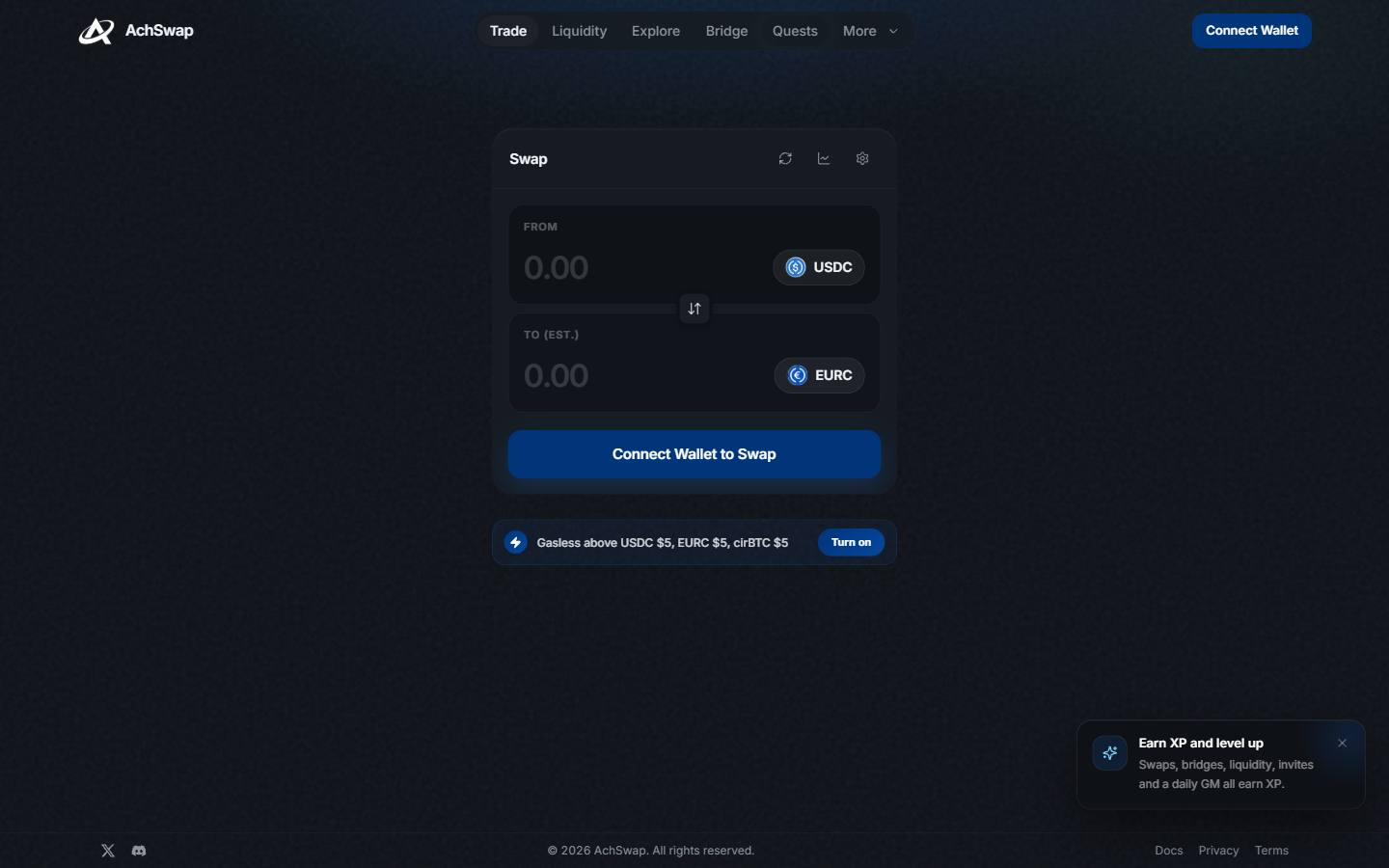
AchSwap swap screen on Arc, with USDC to EURC and a gasless option

The live swap screen, captured 29 November 2026. USDC to EURC. Gasless was offered above the minimums shown in the app.

Arc MainnetChain ID 5042. Gas is USDC.
LiveSwap, liquidity, bridge, API, MCP.
0.12%Protocol fee on an AchSwap route, taken once on the output.
No public auditLive contracts are source-verified on ArcScan. Verification is not an audit.

01 — Problem

Arc liquidity does not sit in one pool.

A swap on Arc can touch AchSwap’s own V2 and V3 pools, Uniswap V2, V3, and V4, and other local DEXs. Each one prices differently. Arc also uses USDC as gas, so the same balance is both the asset being traded and the fee that pays for the transaction.

A single AMM interface cannot see that whole book. An aggregator that only forwards to someone else’s router cannot enforce AchSwap’s own execution rules. The product had to own both the search and the settlement.

02 — Architecture

Price off chain. Settle on chain. Keys stay in the wallet.

Browser

AchSwap app

Collects the trade, shows the quote, and asks the wallet to sign.

Servers

API and router

The router keeps pool state in memory, updated from Arc. The API validates requests and applies rate limits.

External

KyberSwap, LI.FI

Independent quotes. The swap page ranks them against AchSwap’s own route after gas.

Arc

Executors

AchRouteExecutorV2 settles an AchSwap route. AchSponsoredExecutorV3 settles a gasless order exactly as signed.

The partner Developer API is the left-hand path only. It returns AchRouteExecutorV2 transactions. It does not return KyberSwap or LI.FI routes.

03 — Routing

An in-memory book, then a simulated plan.

The indexed router discovers pools, follows factory and pool events, and prices candidates with each pool’s own integer math. It searches direct routes and routes through one or two hubs, and it can split a trade across pools. The public docs describe this as up to three hops.

Before an AchSwap quote is shown, the plan is executed as an eth_call against the live contracts. The number on screen is what that call paid at that block. It is exact for that state, and it is not a promise about the next block. If the pools move before mining, the on-chain minimum either holds or the transaction reverts.

04 — Execution

One transaction, adapters, a fee, a minimum on the balance you actually receive.

AchRouteExecutorV2, deployed 20 October 2026, executes the route in one transaction. A plan can carry up to 8 branches and 32 steps. Adapters settle V2 pairs, V3 and Slipstream pools, Uniswap V4 including hooked pools, Lunya pools, and Virtuals launch curves. The executor does not discover the route. The router does. Anyone can encode a plan.

The contract pulls only the caller’s input, charges 0.12% once on the final output, and pays that fee to the treasury Safe in the same transaction. The fee cap in the contract is 1%. A fee increase waits two days, and a plan built under the old fee does not silently pay the new one. The recipient’s balance has to rise by at least the minimum, or the whole call reverts. The executor holds nothing between transactions.

AchSwap’s own V4 liquidity contracts are not deployed. Uniswap V4 is routed as an external protocol. V2 and V3 liquidity on AchSwap’s own factories is live, including concentrated ranges at 0.01%, 0.05%, 0.3%, 1%, and 10%.

05 — API

Quotes and ready-to-sign transactions for other applications.

The Developer API is live by API key. An integrator can request a quote and a swap transaction for AchSwap’s router, with an optional fee for their own app. Identical quotes inside a few seconds share one result. The API simulates swap transactions from the sender when it can, and it says so when a simulation did not run.

Announced publicly on 9 October 2026. The reference is in the docs, not a private spec.

06 — Gasless

One Permit2 signature. A relayer pays the gas. The contract checks the signature.

Gasless swaps are live for exact-input trades from USDC, EURC, or cirBTC, above a minimum the app shows. On 29 November 2026 the swap screen displayed USDC $5, EURC $5, and cirBTC $5. The first use of a token still needs an ordinary approval to Permit2. After that, the user signs one witness that binds the token, the amount, the target, the output, the minimum, the recipient, and a hash of the calldata.

AchSponsoredExecutorV3 pulls exactly that input through Permit2 and calls an allowlisted target: KyberSwap, LI.FI, or AchRouteExecutorV2. An allowlisted relayer can submit the order unchanged, or not submit it. It cannot rewrite the trade. The nonce can be used once. The relay refuses deadlines more than three hours ahead. If the call reverts, the Permit2 transfer reverts with it and the relayer has paid the gas.

07 — Security boundaries

What the chain enforces, and what it does not.

There is no published independent audit. The team has done internal review. The docs say that plainly, and they say an internal review is not an audit. Live AchSwap contracts were source-verified on ArcScan, last checked in the docs on 20 October 2026. Source verification shows the bytecode. It does not prove the code is safe.

The owner of AchRouteExecutorV2 can pause, disable an adapter, and schedule a new adapter or a higher fee behind a two-day delay. The owner cannot move user funds, retarget an existing adapter id, or apply a new fee to a plan built under the old one. Contract ownership currently sits with the deployer address, not a multisig. The fee recipient is the treasury Safe.

KyberSwap and LI.FI routes settle on those protocols’ contracts. Bridge timing is LI.FI’s. Explore market data comes from DEX Screener. A hook, a token tax, or a moved pool can change the result. The minimum is the protection that still applies.

08 — Agents and MCP

An assistant can prepare a trade. It cannot hold the key.

AchSwap runs a remote MCP server at trade.achswap.app/mcp. Claude, ChatGPT, Cursor, and other clients that speak remote MCP can read balances, tokens, prices, and pools, and can prepare swaps, bridges, and liquidity changes. This is live.

Manual mode sends every transaction through the user’s own wallet. Steps are simulated first. Approvals are for the exact amount unless the user turns on unlimited approval. Prepared transactions expire. At most five sit open, and one is sent per wallet at a time.

Automatic mode trades from an agent wallet: a MetaMask Delegation Framework smart account that the user’s wallet owns. The chain allows calls only to AchSwap’s executor, AchSwap’s V2 router and V3 position manager, and pinned LI.FI bridge targets, and only from AchSwap’s relayers, until the permission expires or the user revokes it. Per-trade size, daily limits, slippage, and verified-token checks are AchSwap’s own checks, not the chain’s. A compromised relayer could trade badly inside those fences, up to what was deposited. The docs tell users to deposit only what they want an assistant to trade.

09 — A year of building

Not a weekend project. A protocol that moved from a first repository to mainnet.

  1. The first AchSwap repository is created. That is the earliest date I can show in Git history.
  2. The v3 application repository and a separate MCP repository exist.
  3. A dedicated API repository is opened.
  4. The contracts monorepo is opened. It is private.
  5. The current application monorepo is assembled and is still the tree I work in.
  6. Listed in the Circle Alliance Directory. Routing work includes V3 adapters and an exact-output quoter.
  7. Developer API is announced. AchRouteExecutorV2 replaces the previous executor. Older gasless executors are paused. MCP permission-based execution is the model that shipped.
  8. Mainnet app, docs, gasless swaps, liquidity, bridge, and the agent wallet are the live system.

What I am not claiming. No audit, no grant, no Circle investment, and no volume or user counts. The application repository is private, so this page links the public AchSwap organization instead. The behavior above is what that repository and the public docs both describe, and what the live app exposes.

02 · AI agent security

WardGate

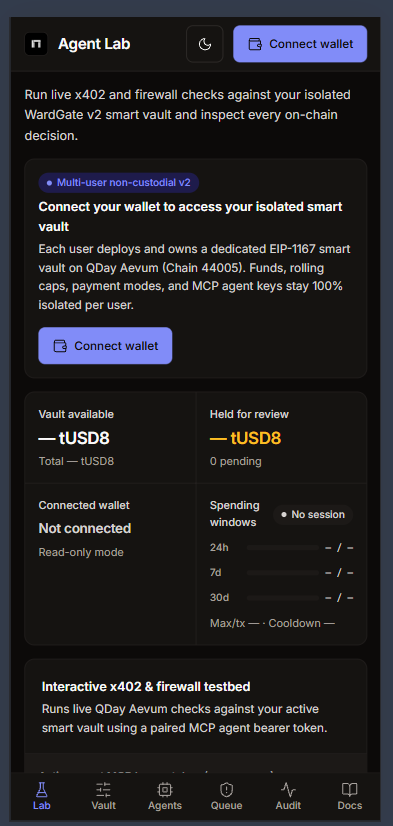
WardGate is a non-custodial payment firewall for AI agents. Each user deploys an isolated EIP-1167 vault, funds it with tUSD8, and lets an MCP client pay only inside limits the vault enforces. It is live as a testnet system on QDay Aevum, chain 44005, not on a mainnet.

The vault factory clones a personal vault the user’s wallet owns. Deposits can use EIP-2612 permit. A session carries a per-payment cap, an auto-approve ceiling, rolling 24-hour, 7-day, and 30-day budgets, a cooldown, and an allowlist or denylist. A pending payment reserves budget immediately so a queue cannot lock the rest of the vault. Rejecting it refunds that reservation. Automatic mode can pay a merchant when the rules pass. Manual mode, or a trust score under the floor, leaves the payment in an on-chain queue.

The MCP gateway is an HTTP server. Agents authenticate with a bearer token. Off-chain session metadata sits in Turso and is gated by Sign-In with Ethereum plus a live check that the caller owns the vault. An ERC-8004 registry in the repo is the trust record the firewall consults. The live console also runs x402 payment checks against the vault.

Project creator, product architect, and technical lead. I originated WardGate and designed the application: the architecture, the smart-contract design, the payment execution model, and the user flow. I planned the technical work, defined the implementation, directed it, designed the UI, and tested and validated the features. I led that development and supervised the implementation. I did not write every line of the code.

Jubair (jubayir-hub-69) contributed coding and implementation under that technical direction. His repository commits include the initial release and the v2 work on multi-user vaults, the ERC-8004 registry, and the streamable HTTP MCP.

WardGate Agent Lab on QDay Aevum, showing an isolated vault and x402 checks

wardgate.vercel.app, 29 November 2026. Agent Lab, vault policy, quarantine, and audit log are in the product.

Network
QDay Aevum testnet, chain 44005. Token tUSD8, 6 decimals.
Stack
Solidity, Hardhat, ethers, OpenZeppelin, JavaScript, Turso, Vercel.
Repository
Public fork. Same commit history as jubayir-hub-69/WardGate.

03 · Market mechanism

FairBatch

FairBatch collects orders into a round and clears the filled orders at one price. Sequential AMM execution pays the first transaction a different price from the last, which is how a sandwich extracts value. A uniform clearing price is meant to make that intra-round difference zero. The pricing kernel is written so the Fe compiler treats it as effect-free.

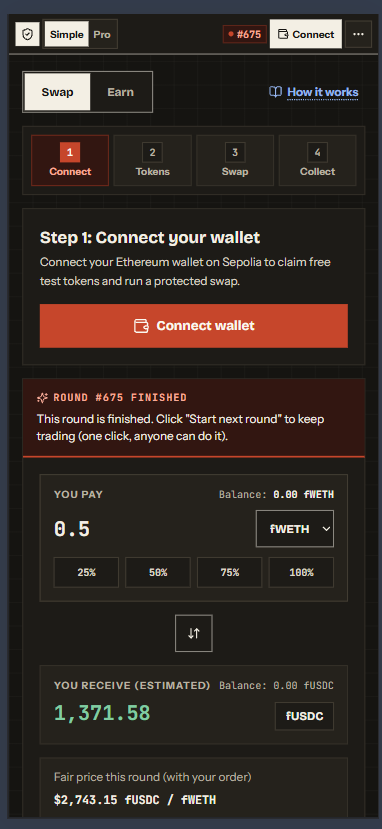
The contracts are Fe 26.5.0. Orders can be direct, sealed commit-reveal, or EIP-712 and ERC-1271 signed intents. The repository includes the clearing, intent, and math modules, a Rust reference tool, a permissionless keeper, and a React terminal with Simple and Pro modes plus an MEV simulator. It is deployed on Ethereum Sepolia. The web app reads that chain from the browser. The keeper is optional. Without it, a user can start the next round.

Project creator, product architect, and lead developer. I originated FairBatch and designed the application: the architecture, the smart-contract design, the execution model, and the user flow. I implemented it and completed the demo, including the clearing contracts, the Sepolia deployment, the keeper, and the terminal. I tested and validated the features.

The repository began as the Fe Builders Challenge starter. Jubair later tested the demo and contributed a few additional changes.

FairBatch web app syncing Ethereum Sepolia state

app.fairbatch.xyz, 29 November 2026, while the app was reading the current Sepolia round. The footer identifies the Fe 26.5.0 clearing function.

Network
Ethereum Sepolia. This is a live testnet deployment, not mainnet.
Stack
Fe 26.5.0, TypeScript, React, viem, a Rust reference solver, Node keeper.
Price
One clearing price per round. I am not claiming a formal MEV proof beyond the tests named in the repository.

Other work

The rest of what is deployed.

A GitHub link is shown only when that repository is public. A live link is shown only when the site is up. A project with both gets both.

Mon Bridge Dex

Static site for a Monad DEX: swap, add liquidity, and remove liquidity. The live page title is “Mon Bridge Dex - Advanced DEX Aggregation for Monad Ecosystem”. The repository vendors ethers.js, which GitHub linguist did not count as JavaScript.

HTML 82.3% · CSS 17.7%

A Dev Studio

Desktop-class JavaScript IDE for Android. The public repository is MobileIDE: a React Native app with a Monaco editor, on-device terminals, and a bundled runtime for Node, npm, Python, and Git. Kotlin manages that runtime. C++ provides the PTY. version.json in the repository is 1.3.36. The live sites are the product landing page. The page title checked on 29 November 2026 included v1.3.35.

Application code is React Native, TypeScript, Kotlin, and C++. The repository also vendors the on-device runtime, so GitHub’s raw byte count is mostly that runtime’s C, C++, and Python.

P2P MarketplaceHandmade

Wallet-connected marketplace. The page title is “Decentralized Marketplace”. Buy and sell call a contract that stores orders.

JavaScript 53.9% · HTML 27.3% · CSS 18.9%

AchMarket

Decentralized prediction market on ARC Testnet. Markets trade outcome tokens with LMSR. Solidity contracts, plus a React, Vite, and TypeScript frontend.

No live site. The Vercel address was not serving the app on 29 November 2026.

TypeScript 90.3% · Solidity 6.2% · CSS 1.8% · JavaScript 1.2% · HTML 0.6%

Tic Tac ToeHandmade

Monad tic-tac-toe dApp. The page title is “Tic Tac Toe DApp” and the heading is “Monad Tic Tac Toe”. It connects a wallet and shows a token balance.

HTML 48.6% · JavaScript 40.3% · CSS 11.2%

AchSwap Mail

Team mailbox for AchSwap. Personal, support, and admin mail, with threads, search, compose, and reply. Outgoing mail goes through Resend. Incoming mail arrives through Cloudflare Email Routing and is stored in Turso. No Gmail sync.

JavaScript 82.6% · CSS 12.8% · HTML 4.6%

Buildswap

DEX UI for Arc Testnet, built with Vite, React, and TypeScript. The same public repository contains the Solidity contracts and a subgraph. Pools come from a subgraph when one is configured, otherwise from RPC. That repository is not connected to the Vercel project, so the live site is not auto-deployed from GitHub.

TypeScript 49.6% · Solidity 39.0% · CSS 5.6% · JavaScript 5.6% · HTML 0.3%

gm Launch

Bonding-curve token launchpad on Base. A token is created with a name and a ticker, traded on a constant-product curve, and can graduate to Uniswap V2 at 5 ETH with the LP burned. Packages default to Base mainnet, chain id 8453.

No live demo. It is not for use, so a visitor does not send a Base mainnet transaction by accident.

TypeScript 87.6% · Solidity 9.4% · JavaScript 2.0% · CSS 0.9% · HTML 0.1%

Ach Agent

A real BNB Chain trading agent. It uses Binance Agent OS for market data and compares routes across PancakeSwap V2, PancakeSwap V3, Uniswap V2, Uniswap V3, and LI.FI. Run it from the repository with npm run smoke or npm run demo. A local Next.js screen exists in the repo and is not hosted. License AGPL-3.0-only.

No deployed site.

TypeScript 99.6% · CSS 0.2% · JavaScript 0.2%

Technical expertise

What the repositories actually contain.

No skill bars. These are the domains I work in, named from the code and the docs, not from a template.

Protocol engineering

  • Solidity execution contracts and adapters
  • Fe batch-clearing contracts
  • EIP-1167 vaults and permit deposits
  • On-chain minimums and fee delays

Trading infrastructure

  • Indexed pool state and route search
  • Split routes and multi-hop quotes
  • Simulation before a quote is shown
  • Uniform-price batch clearing

Backend engineering

  • Quote and swap API
  • Gasless relay
  • Node services, Vite apps, Vercel and Render deploys
  • Subgraph and pool indexing around AchSwap

AI agent engineering

  • Remote MCP for trading
  • Manual approval versus automatic mode
  • Delegation-framework agent wallets
  • Payment policy, quarantine, and revocation

Recognition

What is public, and what it does not mean.

Circle Alliance Directory

AchSwap is listed. Circle does not endorse it.

The official listing is on Circle’s Alliance directory. It describes AchSwap as decentralized exchange and liquidity infrastructure on Arc, in the DeFi and Bridge categories, with Arc as the supported chain. The page was last updated 22 September 2026.

Circle’s own disclaimer on that page says a listing is third-party content and is not an endorsement, recommendation, or validation. I am not claiming a grant, an investment, an audit, or a security guarantee.

partners.circle.com/partner/achswap

Public note from an Arc architect

A published account of using the protocol.

“Just provided liquidity on AchSwap on Arc mainnet. I added liquidity to the USDC/EURC pool.”

Manny (@0x_manny1), whose X bio describes him as Architect at Arc, posted that on 9 October 2026. He named V2 and V3 liquidity, routing across DEXs, and USDC gas. That is one person’s public post, not an official Arc award.

Read the post

About

I build the system, and I stay in the code.

I am Asif Iqbal. GitHub knows me as Asif2902. I founded AchSwap and I am the principal engineer on it. The work is product conception, architecture, smart contracts, routing, APIs, agent integration, deployment, and the maintenance that comes after mainnet.

The first AchSwap repository dates from November 2025. Since then the system has gone through a testnet-era codebase, a v3 rewrite, a separate contracts repository, a public developer API, gasless execution, and an MCP server that can trade only inside a permission the user signed. I still ship on that line.

WardGate and FairBatch sit under AchSwap. I created both, designed them, and led them through to working products. On WardGate I was the product architect and technical lead, and Jubair implemented under that direction. On FairBatch I was the lead developer and completed the demo. Jubair later tested it and made a few further changes. The other shipped work is in the list above: the Android IDE, Monad and Arc apps, the mail tool, the agent, and the two handmade dApps.

How I work

  • Hands on the implementation, not only the diagram.
  • Mainnet behavior has to match the docs.
  • A missing audit stays labeled as missing.
  • Other people’s commits stay attached to their names.

Contact

Write, or read the code that is public.

The email below is the address published in AchSwap’s security docs. I have not put a personal inbox on this page.